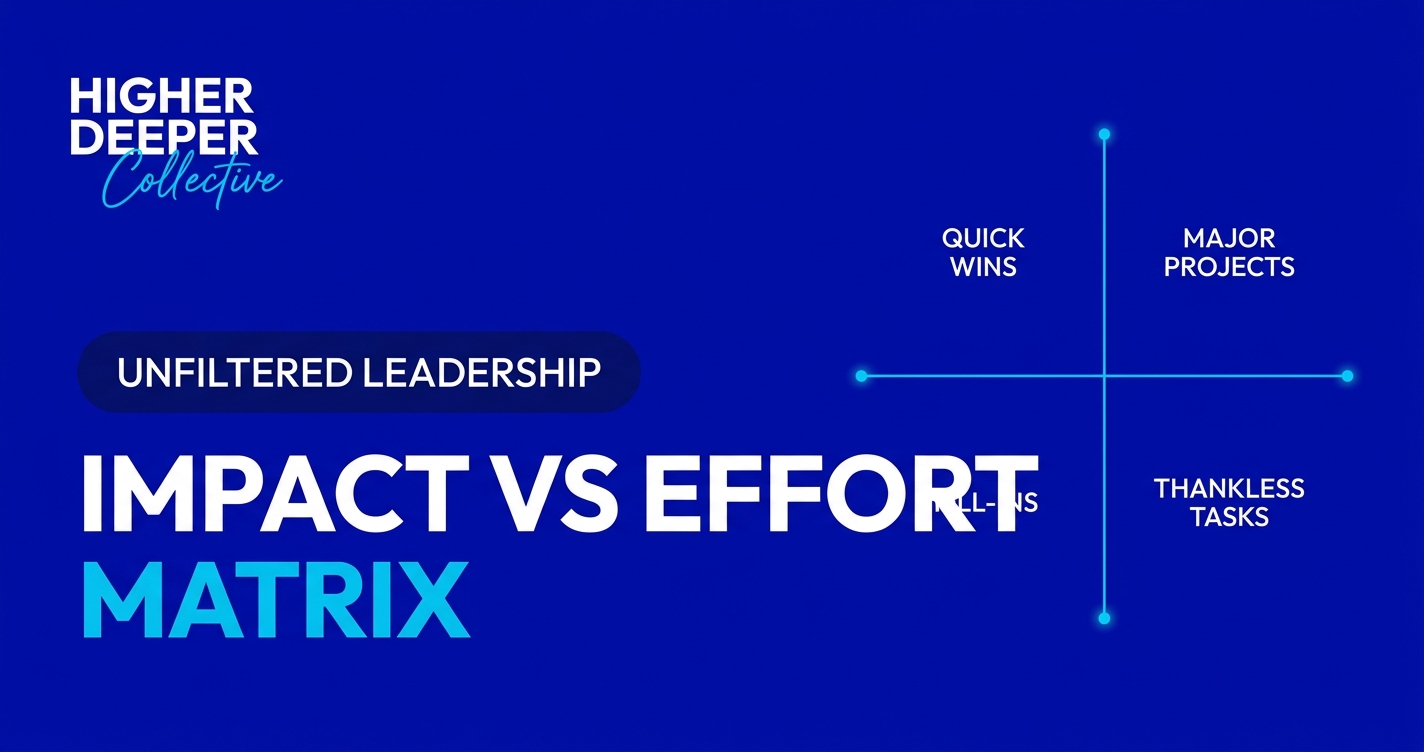
The 2×2 I use with executive coaching clients to clear their Monday stack in under five minutes, and the interactive tool you can run right here.
Most of the leaders I coach arrive carrying 47 urgent things and eight usable hours.
Not a time problem. A decision problem. By the time they call me, they’ve already tried time-blocking, Getting Things Done, the Eisenhower matrix, three productivity apps, and a weekend retreat where somebody promised them “systems thinking.” The real issue isn’t that they can’t work harder. It’s that every item on their list looks equally important at 9am Monday morning, and urgency keeps beating strategy until one of them burns out.
The Impact vs Effort Matrix is the simplest decision tool I know for breaking that tie. Not another framework to add to the library. A 2×2 that tells you, in about five minutes, what to actually do Monday morning and what to drop, delegate, or defer.
I’ll walk you through it, then give you the interactive version you can run with your own list right now.
What the matrix actually is
Two axes. Four quadrants. That’s the whole thing.
The vertical axis is Impact, how much does this move a goal that actually matters? Not “is it satisfying to finish.” Not “did someone else put it on my list.” Impact. If I don’t do this, what doesn’t happen?
The horizontal axis is Effort, how much of my limited attention, team bandwidth, or political capital will this genuinely cost? Not optimistic-Monday effort. Real effort. The effort you’d bet on.
Plot every item on your current leadership list and they’ll fall into one of four spaces:
- Quick Wins (high impact, low effort), do these first, this week
- Major Projects (high impact, high effort), block time on the calendar, protect it
- Fill-Ins (low impact, low effort), batch them or delegate, don’t schedule them
- Thankless Tasks (low impact, high effort), the ones you must stop doing, and usually can’t admit yet
Most leaders I work with are over-invested in the bottom-right quadrant and feel too busy to touch the top-right.
Why this beats priority matrices you’ve already tried
You’ve probably met the Eisenhower matrix (urgent × important). It’s useful for email triage. It isn’t useful for leadership decisions, because almost everything on an executive’s list is both urgent and important, that’s how it got to you.
You’ve probably met the ICE score or RICE framework. Great for product teams triaging features. Way too heavy for a Monday morning clear-out.
The Impact/Effort matrix works because it forces two honest conversations with yourself:
- Am I being realistic about impact? Most leaders overestimate impact on work they enjoy doing and underestimate impact on work they’re avoiding.
- Am I being realistic about effort? Most leaders underestimate the effort a task costs their team even when it feels light to them.
You don’t need a spreadsheet. You need five minutes and a willingness to be honest about both axes.
How to run it in under five minutes
Step one, write out your current leadership list. Not your calendar. Not your inbox. The 10-15 things you’re actively carrying: the decisions pending, the projects you’re the keeper of, the conversations you haven’t had yet. Paper, Notes app, sticky pile, whatever.
Step two, for each item, ask: if I don’t get to this in the next two weeks, what actually happens? If the honest answer is “nothing much,” it’s low-impact. If the honest answer involves someone missing a number, a team member stalling, a client relationship cooling, a strategic window closing, it’s high-impact.
Step three, for each item, ask: realistically, how much of me does this cost? Not calendar hours. Think: how much decision-fatigue, how many follow-ups, how much political capital. Light, medium, or heavy.
Step four, plot each item on the 2×2. Use the interactive tool below if you want the visual, or just scrawl it.
Step five, look at the bottom-right quadrant (low impact, high effort). Those are the thankless tasks. Pick one to stop doing this week. Not delegate. Stop.
Try it — your own list, right now
Plot your leadership list
Type each thing you’re carrying, hit Add, then drag it to the right spot on the grid. Higher up = more impact. Further right = more effort.
Two leadership examples
The Ministry Operations Lead
I was coaching a pastor running a 40-person church operation last quarter. She’d come in feeling like she was drowning. We mapped her current list on an Impact/Effort matrix in one coaching session.
Her top-right quadrant (Major Projects): the succession plan for her worship director, the Q3 budget re-forecast, the safeguarding policy overhaul. All high-impact, all high-effort, all sitting “in progress” for months.
Her bottom-right (Thankless): managing the volunteer roster WhatsApp group, drafting the monthly newsletter herself, re-approving expense reports her treasurer had already approved.
The five-minute exercise surfaced something she hadn’t been able to say out loud: she was avoiding the high-impact work by staying busy with the low-impact work. The matrix didn’t tell her that. It just put the evidence in two quadrants she couldn’t unsee.
She stopped the newsletter draft that week. Two months later, her worship director succession plan shipped.
The Chief of Staff
Another client, Chief of Staff at a Series B startup. He ran the matrix and found something different: his bottom-right wasn’t overloaded. His top-left (Quick Wins) was empty.
That’s a pattern I see often in operators who pride themselves on strategy. They avoid Quick Wins because those feel beneath their pay grade, when in fact the Quick Wins are what build the political capital needed to do the Major Projects.
He gave himself three days of Quick Wins. The team noticed. The next Major Project went 40% faster because he’d repaired three small relationships in the margins.
What the matrix won’t do
It won’t tell you whether something is worth doing in principle, that’s a values conversation, not a framework conversation.
It won’t survive a crisis week, because everything looks high-impact under stress. Run it in a calm moment, not a panicked one.
It won’t replace the deeper question “am I in the right role?”, which is the question most of my coaching conversations actually end on. If every week you run the matrix you find the same items stuck in the top-right, that’s not a decision problem. That’s a capacity problem, and sometimes a calling problem.
For that, you’ll want a longer conversation than a 2×2 can hold. That’s what the Collective is for.
Your next step
Run the interactive tool above with your actual list. Five minutes. Screenshot the result if it surfaces something you want to sit with.
If you want the deeper work, the coaching conversation behind the matrix, two ways in:
- Take the Leadership Pulse Check. Fifteen questions, five minutes, tells you where you’re actually leading from. Free.
- Join the Collective at $12/month. Weekly Monday reset, monthly live Q&A, LinkedIn community of executives and ministry leaders running the same frameworks. The matrix is one of six tools in the pocket.
Most leaders don’t need another framework. They need somebody telling them the truth about the ones they already have.
— Sue