
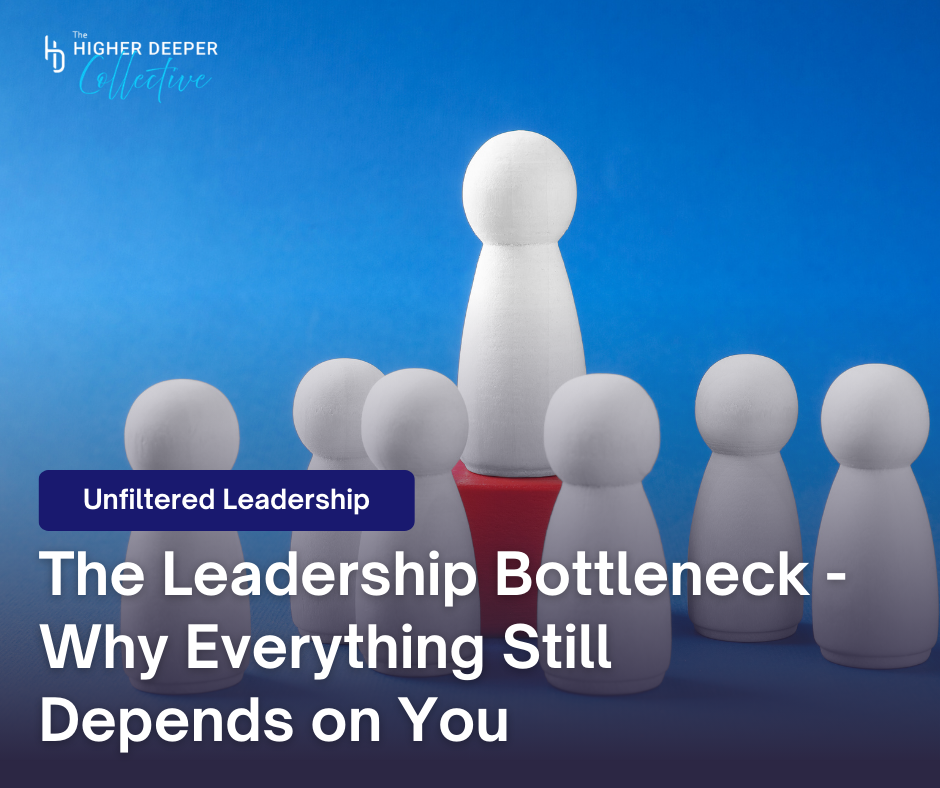
If your team cannot move without you, then you are not truly leading in a scalable way, you are unintentionally limiting the very growth you are trying to create.
This is one of the most frustrating and often invisible challenges in modern leadership, because on the surface everything appears to be functioning well, yet beneath that surface, progress still slows without your involvement, decisions continue to come back to you, and your calendar remains consistently full regardless of how much you attempt to delegate.
This is not a problem of capability or effort.
It is a leadership bottleneck.
And in many cases, the leader themselves is unknowingly the source of that constraint.
Understanding What a Leadership Bottleneck Really Is
A leadership bottleneck occurs when too many decisions…responsibilities, and problem solving pathways are routed through one individual, typically the leader, rather than being effectively distributed across the team.
In the early stages of leadership, this can feel like a strength, because you remain close to the work, maintain high standards, and ensure that nothing slips through the cracks.
However, as the organisation grows, this same behaviour begins to create friction that limits both speed and scalability.
Teams begin to hesitate instead of acting with confidence, leaders become reactive instead of strategic, and the organisation struggles to move forward without constant input from a single person.
According to the Australian Institute of Company Directors, effective leadership requires a deliberate shift away from operational control toward strategic oversight, yet many leaders remain deeply embedded in execution, which prevents them from leading at the level required for growth.
The Subtle Signs That Everything Still Depends on You
Most leadership bottlenecks do not appear suddenly, but rather develop gradually over time as leaders take on more responsibility and become increasingly relied upon by their teams.
One of the clearest signs is that even capable team members still seek your approval before making decisions, which indicates that decision ownership has not been fully transferred.
Another indicator is that your calendar is consistently filled with meetings, approvals, and problem solving conversations, leaving little to no space for strategic thinking or long term planning.
You may also notice that progress slows significantly when you are not available, which suggests that the organisation is operating around your presence rather than independent systems.
Perhaps most telling is the internal experience of feeling responsible for everything, even when others are technically accountable, which creates a constant sense of pressure and mental load.
These are not signs of strong leadership.
They are signals of a system that is too dependent on one person.
Why High Performing Leaders Become the Bottleneck
The leadership bottleneck is rarely created by lack of skill or commitment, but rather by the very strengths that made the leader successful in the first place.
Highly capable leaders tend to step in because they can solve problems quickly, maintain quality, and keep things moving when others are uncertain.
This behaviour is often reinforced by positive feedback, which encourages leaders to continue stepping in rather than stepping back.
Over time, however, this creates a pattern where the leader becomes the default solution for every problem, which prevents the team from developing their own capability.
This is closely related to what many leaders experience as overfunctioning, where they consistently take on work that others should be learning to do themselves.
While this may create short term efficiency, it builds long term dependency.
The Hidden Cost of Being the Bottleneck
The impact of a leadership bottleneck extends far beyond the leader’s workload, affecting the entire organisation in ways that are often difficult to see until they become significant.
When leaders hold too much responsibility, teams are denied the opportunity to develop critical thinking, decision making, and leadership skills, which limits both individual growth and organisational capability.
At the same time, the leader experiences increasing pressure, as they become responsible for more decisions and outcomes than is sustainable.
According to Safe Work Australia, excessive workload, unclear role boundaries, and sustained pressure are key contributors to workplace stress, particularly for those in leadership roles.
This means that leadership bottlenecks not only limit performance, but also significantly increase the risk of burnout.
In addition, when leaders are constantly involved in execution, they lose the ability to focus on strategy, which ultimately impacts the long term direction of the organisation.
The Critical Shift From Doer to Designer
Breaking free from a leadership bottleneck requires a fundamental shift in how leadership is approached, moving from being the person who does the work to the person who designs how the work gets done.
Doers focus on completing tasks and solving immediate problems, while designers focus on creating systems, structures, and clarity that prevent those problems from recurring.
This shift allows leaders to operate at a higher level, where they are shaping direction rather than reacting to issues.
The Australian Public Service Commission highlights that effective senior leadership requires judgement, systems thinking, and the ability to operate with a long term perspective, rather than being absorbed in day to day execution.
This is the level of leadership required for sustainable growth.
Why Delegation Alone Is Not Enough
Many leaders attempt to solve this problem by delegating more tasks, but delegation alone does not remove the bottleneck if the underlying leadership behaviour remains unchanged.
If leaders continue to review, correct, or override decisions, then the team does not experience true ownership, and dependency remains.
Effective delegation requires trust, clarity, and a willingness to allow others to learn through experience, even when that includes mistakes.
The goal is not to eliminate risk entirely, but to build capability over time.
Without this shift, delegation becomes superficial rather than transformative.
How Business Coaching Unlocks Leadership Capacity
This is where business coaching becomes a powerful tool for leadership transformation, because it provides the structure and perspective needed to identify patterns that are often invisible to the leader.
Through business coaching, leaders are able to examine how they are making decisions, where they are holding too much control, and how their behaviour is influencing team dynamics.
Business coaching helps leaders develop the ability to:
- distribute decision ownership effectively
- create systems that reduce reliance on them
- build team capability and confidence
- focus on strategic priorities rather than constant execution
This is why many leaders across Australia turn to business coaching and executive coaching when they reach a point where effort alone is no longer enough to drive results.
Three Practical Shifts You Can Start This Week
If you want to begin breaking the bottleneck immediately, there are several practical shifts that can create meaningful change.
First, move from answering questions to asking better questions, which encourages your team to think independently rather than relying on you for direction.
Second, shift from fixing problems to clearly defining them, which allows others to engage with the issue and take ownership of the solution.
Third, replace control with clarity, ensuring that expectations, priorities, and decision boundaries are clearly understood so that your team can act confidently without constant input.
These changes may feel small, but they fundamentally alter how leadership operates within your organisation.
Leadership That Scales Beyond You
Leadership that truly scales is not dependent on one person, but is supported by systems, clarity, and capable people who can operate independently.
Leaders who achieve this level of effectiveness spend more time thinking than reacting, invest in developing others rather than doing the work themselves, and focus on long term outcomes rather than short term fixes.
This is the difference between being needed and being effective.
You Do Not Have to Solve This Alone
If this pattern feels familiar, it is important to recognise that you are not alone, and that this is one of the most common challenges faced by capable leaders.
It is also why The Higher Deeper Collective was created, to support leaders in making the shift from overfunctioning to strategic leadership.
Inside the Collective, leaders are guided through the process of identifying bottlenecks, redesigning their leadership approach, and building systems that allow their teams to operate with greater independence and confidence.
Your Next Step
If everything still depends on you, it is not because your team lacks capability, but because your leadership system needs to evolve.
You have carried the weight of the organisation long enough, and it is time to build a way of leading that allows others to carry it with you.
👉 Join The Higher Deeper Collective
Step out of constant execution and into strategic leadership.
Build a team that thinks, decides, and leads alongside you.
Frequently Asked Questions
What is a leadership bottleneck
A leadership bottleneck occurs when too many decisions and responsibilities depend on one leader, which slows progress and limits the organisation’s ability to scale effectively.
How do I know if I am the bottleneck
You may be the bottleneck if your team constantly seeks your approval, your calendar is overloaded, and progress slows when you are not available.
Why do leaders become bottlenecks
Leaders often become bottlenecks because they are highly capable and step in to solve problems quickly, which unintentionally prevents their team from developing independence and decision making capability.
Can business coaching help fix leadership bottlenecks
Yes, business coaching helps leaders identify where they are holding too much responsibility and provides strategies to distribute decision making, improve systems, and build team capability.
What is the difference between delegation and leadership design
Delegation focuses on assigning tasks, while leadership design focuses on creating systems, clarity, and structures that allow teams to operate independently without constant oversight.
How does a leadership bottleneck lead to burnout
When leaders carry too many responsibilities and decisions, they experience sustained pressure and reduced clarity, which significantly increases the risk of burnout over time.